
Walking more than one dog at a time sounds efficient. One walk, everyone exercised, done.
Right? Well… sometimes, it can look more like a small-scale circus. Leashes crossing, dogs switching sides, tripping over leashes, one dog stopping to sniff while the other suddenly spots a squirrel three blocks away.
Walking multiple dogs can be safe and enjoyable, but only if a few key conditions are in place. Otherwise, it’s often better (and safer) to walk them separately.
Here’s what to know before you clip on that second leash.
1. Start With the Dogs in Front of You (Not the Idea)
Before thinking about gear or techniques, ask yourself a few honest questions about the dogs themselves:
- Are they similar in size and strength?
- Can they walk at roughly the same pace?
- Are they reactive to other dogs, people, bikes, or cars?
- Do they have basic leash manners individually?
Two calm dogs with loose-leash skills are a completely different situation than one calm dog paired with one anxious puller. When one dog is constantly correcting the other, tension travels straight down the leash — and onto you.
Rule of thumb:
If you wouldn’t enjoy walking each dog alone, walking them together will almost always magnify the problem.
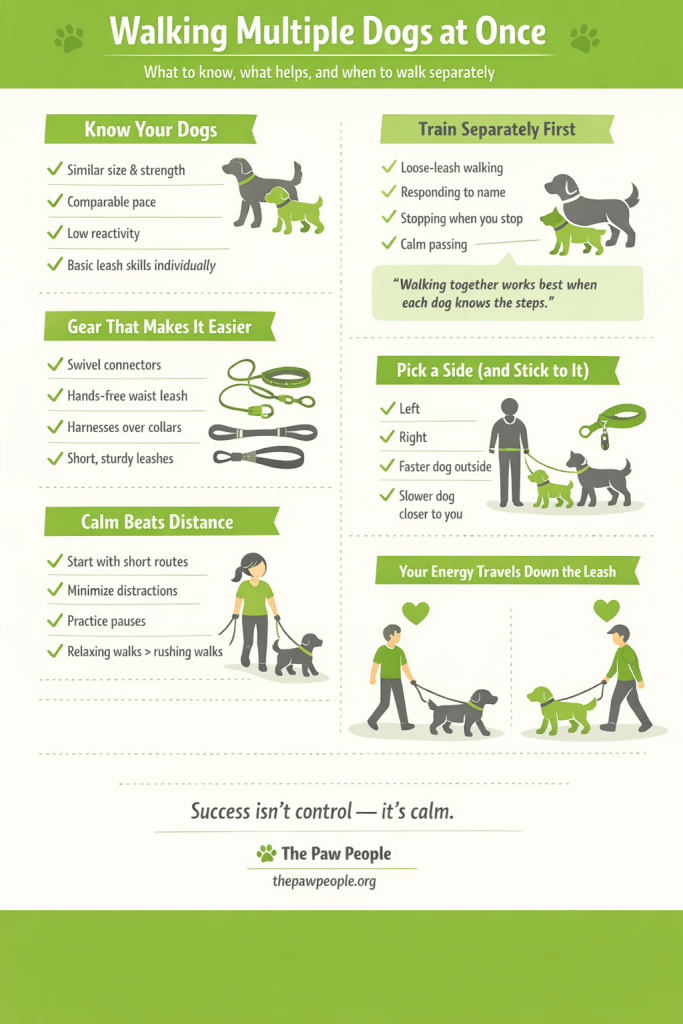
2. Train Separately First (Even if You Plan to Walk Together)
One of the biggest mistakes people make is assuming dogs will “figure it out” together.
They won’t.
Each dog should already understand:
- Walking without pulling
- Responding to their name outdoors
- Stopping when you stop
- Not crossing in front of you constantly
Once those skills exist individually, walking together becomes a matter of coordination, not control.
You and your furry family are essentially dance partners. And you don’t learn choreography while tripping over each other; you start with learning the individual steps.
3. Use the Right Setup (It Matters More Than You Think)
The wrong gear can turn a manageable walk into chaos.
Helpful tools for multi-dog walks:
- Leashes with swivel connectors (they reduce twisting dramatically)
- Hands-free waist leashes for better balance
- Harnesses instead of collars (especially for pullers)
- Shorter leashes, not retractable ones
Long, flexible leashes give dogs more room to cross paths, which is exactly how tangles happen. A slightly shorter leash keeps dogs more aligned and predictable.
Also: avoid attaching two leashes to a single clip on your hand unless the dogs are extremely steady. If one lunges, both feel it.
4. Positioning Is Everything
One small adjustment can change the entire walk.
Many experienced walkers assign “sides”:
- One dog always on the left
- One dog always on the right
It feels rigid at first, but dogs adapt quickly. This method prevents the constant weaving that causes frustration, as you may already know too well!
If one dog naturally walks faster, let them take the outer position, while the slower or more sniff-focused dog stays closer to you.
And remember: you don’t need military precision. You’re aiming for predictability, not perfection.
5. Walk With Intention, Not Speed
Multi-dog walks aren’t about distance records.
They’re about:
- Controlled movement
- Mental stimulation
- Safe exposure to the environment
Start with shorter routes. A calm 15-minute walk beats a stressful 45-minute one every time.
If energy levels are high, do a few minutes of calm obedience at the start — simple stops, sits, or direction changes. It helps release nervous energy before it spills into the walk.
6. Watch Your Own Body (Dogs Feel It)
Here’s something people rarely mention:
When walking multiple dogs, your nervous system becomes part of the equation.
Tight shoulders, clenched hands, shallow breathing — dogs read all of it.
If you feel:
- Constantly braced
- On edge about what might happen
- Mentally exhausted afterward
All of those feelings can spread to your dogs.
Remember, dogs respond best to calm, grounded movement. If walking them together makes you tense, they’ll feel that tension too, and act accordingly.
7. When It’s Better to Walk Separately
There’s no shame at all in separate walks! In fact, it’s often the most responsible choice. And, think of it this way: more steps to help you hit your daily step goal.
Consider walking separately if:
- One dog is reactive or anxious
- One dog is significantly stronger
- One or both dogs are hard pullers
- One dog needs slower, sniff-heavy walks (older dogs especially)
- Training is still in progress
- You feel unsafe or overwhelmed
Separate walks allow each dog to:
- Move at their natural pace
- Get individual attention
- Learn without distraction
- Decompress properly
Sometimes walking dogs together is about convenience. Walking separately is about care.
8. A Middle-Ground Option
You don’t have to choose “always together” or “always separate.”
Many people find a rhythm like:
- Morning walks together (short, structured)
- Evening walks separately (longer, more relaxed)
Or:
- Together on quiet routes
- Separate in busy areas
Flexibility is part of good dog care.
Final Thoughts: Walking Multiple Dogs at Once Doesn’t Have to Be Chaos
Walking multiple dogs isn’t about managing chaos. It’s about creating conditions where chaos never takes root.
When the dogs are compatible, the setup is right, and expectations are realistic, walking together can be genuinely peaceful — even grounding.
And when it’s not? Choosing to walk separately isn’t a failure; it’s just a decision you make to keep your attentiveness!
Your dogs don’t need perfection. They need presence, safety, and walks that leave everyone feeling better than when they started.
 The Paw People
Leave a comment